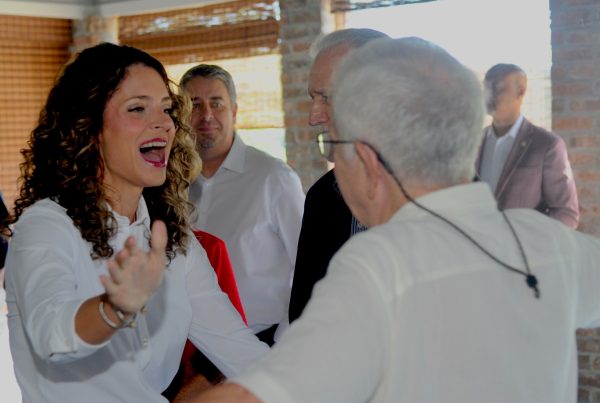
On Saturday Immaculate Conception Catholic Church in Lebeau, a rural Black Catholic parish founded in 1897, unveied the first historical marker ever placed in northern St. Landry Parish.
The effort to secure the marker was led by Augusta Rideau, who helped establish the Immaculate Conception Alumni Foundation for the preservation of the church and its historic grounds and structures. Two years ago, along with a small group of parishioners, began advocating for a historical marker, convinced that Lebeau’s story needed to be protected.They had been watching the shifts, depopulation, aging buildings, the slow fading of rural institutions and felt a responsibility to act.
Rideau’s connection to the parish began long before she helped organize committees or volunteered at “Lebeau Church” as it is often referred. She married in the church in 1975. Her three children were baptized here, made their First Communion here, and were confirmed here. Her four grandchildren followed the same path. Augusta’s life, every major milestone, is rooted in this parish.
“Our ancestors left us a beautiful place, and we needed to find a way to preserve it,” she said.
Immaculate Conception is not simply a place of worship. It is the place where generations of Black families in Petite Prairie, Rideau Settlement, Morrow, Rosa, and the surrounding countryside were baptized, educated, married, buried, and spiritually shaped. It is a parish born because Black families insisted on it. After years of petitioning the Archdiocese of New Orleans for a priest, the Josephite Fathers assigned Fr. Pierre Oscar Lebeau, whose arrival in 1897 was greeted, as he recorded, “in good old Creole fashion,” with parishioners saying in Louisiana Creole French, “Nous content vous vini,” which means “We are glad because you are here.”