Photograph: The Amédé Ardoin Commemorative Area at the St. Landry Parish Visitor Information Center in Opelousas, Louisiana. (Photograph by Freddie Herpin.)
Carola Lillie Hartley
Publisher and Contributing Writer
We invite you to continue to explore historic Opelousas during Black History Month. Here is part two of a list with some historic information that will help you with that tour.
The tour of historic Opelousas during Black History Month continues:
—————————————————————————————————-
5. Holy Ghost Catholic Church of Opelousas

Brief History of the Church: In 1920, Father James A. Hyland came to Opelousas to start a church to serve the African American Catholic population of the town. As soon as he arrived in October of 1920, Father Hyland called a special meeting of all the African American Catholics in Opelousas and the area. The priest announced the move to create a new church parish to serve the Opelousas area population. Since Father Hyland was with the order of the Holy Ghost Fathers, the church was named Holy Ghost Catholic Church. The official charter for the church was filed in December of that year.
Since there was no church building, the celebration of mass and other church services were held in the auditorium of the St. Joseph Catholic School (later renamed Holy Ghost School) on Union Street. And with no rectory available for housing the priest, the good father moved into one of the school rooms until a rectory could be acquired.

St. Joseph Catholic School, founded in 1874, was renamed Holy Ghost School soon after Father Hyland arrived in 1920.
In January of 1921 Holy Ghost Church purchased land that included a building from Rosa Jobin Sandoz. That building became the Holy Ghost Church Rectory.
Immediately plans were underway to raise money so that a church building could be constructed. After several months of fundraising, Father Hyland announced a temporary church would be constructed on Walnut Street, with a more spacious building planned for the future. The church on Walnut Street was completed in March of 1921 and blessed by Bishop Jules Jeanmard of the Diocese of Lafayette.
In October of 1933 the Rev. C. J. Plunkett, the provincial of the Holy Ghost Fathers announced Father Hyland would be transferred to the Mission Band of the Holy Ghost Fathers, with headquarters in Detroit, Michigan. Father Hyland remained at Holy Ghost Church until the end of the 1934 school year.
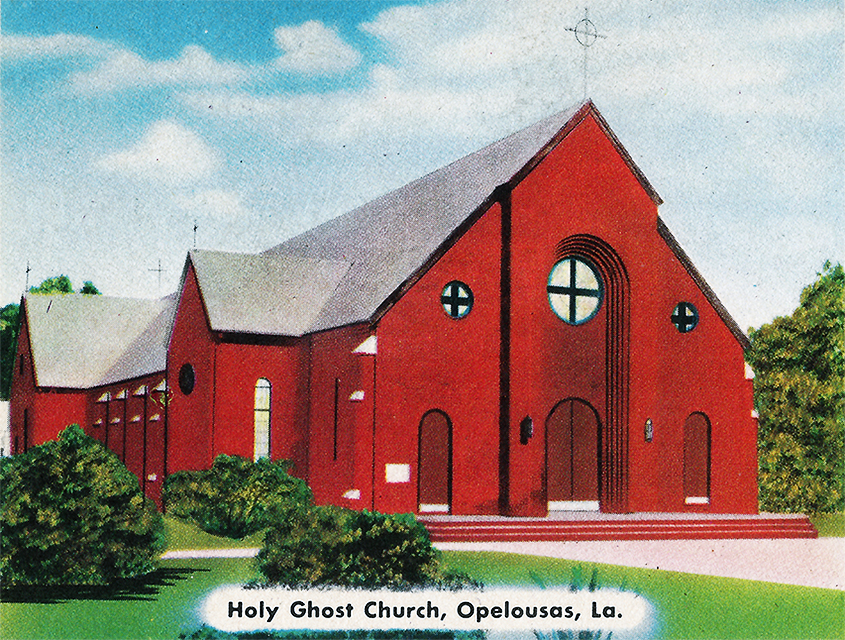
Later another building was used as the church, and in 1948, a new brick Holy Ghost Church was constructed to serve the growing congregation. That new church was dedicated on Sunday, June 5, 1949. Today it remains one of the largest African American Catholic congregations in the nation.
Church Location and Contact Information:
Address: 732 N Union St, Opelousas, LA 70570
Phone: 337-942-2732 Email: secretary@hgcatholic.org
Facebook: https://www.facebook.com/people/Holy-Ghost-Catholic-Church
Web: hgcatholic.org

—————————————————————————————————-
6. Mount Olive Baptist Church and School Historic Marker
Founded in 1891, Mt. Olive Baptist Church in Opelousas is located on West Church Street.

In 1985, the Louisiana Department of Culture, Recreation and Tourism erected a historic marker on the church grounds to highlight the spot where the Black Academy of Mount Olive Baptist Church once stood on West Church Street in Opelousas. The 7th District School was founded at this site in 1897 when there were few schools for Blacks in the area. It operated until 1918.

In 1991, the church celebrated its centennial anniversary. In October of that year the church’s Board of Trustees gathered in front of the Historic Marker that commemorates the school once associated with the Church.
The present church building on the site was constructed in c.1950.
Contact Information
Address: 227 W Church St – Opelousas LA 70570
Phone: 337-594-0976.
——————————————————————————————————
7. Manon Baldwin Corner in Downtown Opelousas
Located near the corner of Court and Landry streets is a historic plaque installed in 2019 marking the Manon Baldwin Corner in Opelousas.
Years ago, some of the street intersections in Opelousas were known as “corners,” named for the businesses located there. It was a way to identify areas around the town, and to give directions such as: “If you are on Pitre’s corner, continue down Court Street to Manon’s Corner and turn left, continue one block to King’s Corner and you will find the St. Landry State Bank.”
The northeast corner of Court and Landry streets was called Manon’s Corner during the mid-1800s to the early part of the 20th century. It was named for Manon Baldwin, the first known businesswoman in Opelousas.

Manon Baldwin Story
In 1805 what would become St. Landry Parish was established, and a short time later the first courthouse was constructed on a lot in what is now the center of downtown Opelousas. It was not long before retail businesses, attorney offices, other business offices and eating establishments located near the courthouse. This became the center of commerce for the parish. Most of the businesses that we’ve heard about were those run by men. But did you know there were women involved in many of those early businesses as well?
The first known woman business owner in what is today downtown Opelousas was Manon Baldwin, a free woman of color (fwc). She was born a slave between 1770 and 1776. In 1809, Manon was freed by Isaac Baldwin, an Opelousas lawyer. At that time, she took Baldwin’s name.
Manon owned several pieces of property in downtown Opelousas and several of her own businesses. She was very active in the community, not just as a businessperson, but also as a humanitarian helping to free other slaves.
Some of her business interests included a “grog shop” (or bar), which was located on a corner of Liberty Street in Opelousas. She also had a cleaning service where she cleaned jails and the courthouse. She had a catering service, a restaurant, a downtown tavern, a funeral service and worked as a nurse. She also owned and ran a boarding house that was located directly across from the St. Landry Parish Courthouse.
Manon Baldwin owned some very valuable property in downtown Opelousas. The description of her property on the corner of Court and Landry streets, directly across from the courthouse, includes references to not just the land, but buildings that were used as a boarding house, a restaurant, a tavern, and as business offices. She owned that property until just before her death in 1857. Could that boarding house have been the same building that was once known as the Eagle Hotel and eventually became the St. Landry Hotel, the Eureka Hotel, and the Lacombe Hotel?
It is interesting to note that during colonial times, women in Louisiana like Manon Baldwin had more rights than women in other areas of the US. Other areas were governed by English Common Law. Louisiana was governed by Civil Law (sometime called the Napoleonic Code). This law gave women some rights that were not afforded to women under the rule of Common Law. Creole women of Louisiana, even those of mixed race, could and did own property, possess assets as single women, or as married women (separate from that of their husbands), file lawsuits, and act as successful and respected business owners. However, they were not allowed all rights. For instance, they could not vote, hold office, pass laws, etc.
Manon Baldwin was considered a Free Woman of Color, or one of the Creoles of Color in Antebellum Louisiana. Creoles of Color are rightfully among the first families of southwestern Louisiana. Yet in the antebellum period in Louisiana, and even after, they were considered apart from the rest of the population. Historians, demographers, sociologists, and anthropologists have given them only scant attention. Yet, Manon Baldwin became an integral part of the community and a dynamic component in Opelousas and St. Landry Parish economy. She died in 1857.
Because of the important role she played in the development of the business center in downtown Opelousas, the seat of Imperial St. Landry Parish, Manon Baldwin was the first parish woman selected by the OGMLA Foundation to be inducted into the St. Landry Parish Women Hall of Fame. The official induction ceremony was held on Thursday, November 10, 2016 at the Delta Grand Theater on Market Street in downtown Opelousas.

—————————————————————————————————-
8. Creole Heritage Folklife Center
The Creole Heritage Folklife Center in Opelousas offers the public an opportunity to relive traditions of the African American community with folklorist, Rebecca Henry. Henry, a St. Landry Parish native offers educational programs and events that focus on Creole heritage. Learn about the use of herbs and folk medicine, everyday tools, home-life, and folk art. In the gift shop, find handsewn quilts, homemade soaps and potpourri, preserves, handcrafted dolls, and artwork. Guided tours are offered weekly and by appointment.

The Creole Heritage Folklife Center is included on the Louisiana African-American Heritage Trail. Ici on parle français. French is spoken here.
What is Creole?
According to Creole Heritage Inc. founder, Rebecca Henry, “‘Creole is family, culture, heritage, and tradition which embodies all that connects the inner and outer families with their ancestral past, not a racial confusion.”
Hours of Operation and Contact Information.
- Tuesday-Friday 12pm-4pm | Saturday 1pm-4pm | Sunday by appointment
- 1113 West Vine Street, Opelousas, Louisiana 70570
- Adults $8, Seniors $7 (64+), Children (12 and under) $5
- Guided tours offered weekly and by appointment.
- 337-945-5064
Rebecca Davis Henry Story
A sharecropper’s daughter, Rebecca Davis Henry was born on February 23, 1941 to Robert Davis, Sr. and Mary Williams Davis. She grew to adulthood in Leonville and graduated from George Washington Carver High School in Sunset. She also attended Bankstreet College in Washington, DC and Southern University in Baton Rouge.

Rebecca Henry is a wife, a mother, a grandmother, a great-grandmother, a poet, a storyteller, a writer, a doll maker, a festival organizer, a teacher, an artist and so much more. As a poet and storyteller, she wrote monthly columns in Creole Magazine before charting articles of her life and culture in her own book of Creole Traditions.
As an organizer she is the founder of Creole Heritage, Inc. and the Creole Heritage Folklife Center in Opelousas. She established the Martin Luther King Celebration in Opelousas that has grown to be a successful annual event. She established other area events as well including Sharecroppers Day, Juneteenth Folklife Celebration and the Creole Cultural Summer Enrichment Program in Opelousas.
Rebecca founded the Creole Quilters, a nine-member group of St. Landry Parish quilt artisans. It was this group that created a St. Landry Parish quilt square for the state’s bicentennial quilt, sewn to celebrate the 200th anniversary of Louisiana statehood in 2012.
Fluent in both English and French, she teachers about folklife tradition, and includes those traditions in her storytelling activities and the articles she writes. She takes part in public discussions about folklore, and practices folk medicine, something she learned from her mother and her grandmother at an early age. As Rebecca says, “We lived in a rural area where there were no doctors. This was our only means of medical attention.” She also taught a class in folklife medicine at the University of Louisiana in Lafayette.
Rebecca is a retired teacher’s aide who helped children with language disorders. She teaches Creole French to adults who want to learn the language of their ancestors. And if that is not enough, she has been an active crafts person since the 1980s, is listed on the Louisiana State Artist Roster, and was accepted into the Louisiana Crafts Marketing Program for her Creole Dollhouse Collection and Okra Angels. Okra Angels are made from okra pods and Spanish moss. These creations pay tribute to enslaved Africans, who brought okra to the US in the locks of their hair. Each hand-painted angel has an okra seed nestled in their hair in commemoration of this custom.
Rebecca has been a featured folklife presenter at festivals and forums throughout Louisiana, including Festival International de Louisiana, New Orleans Jazz & Heritage Festival, Southwest Louisiana Zydeco Music Festival, Creole Festival, Festival Acadiens, Shadows-on-the-Teche and Vermilionville’s Creole and Cajun Day.
Rebecca has received several awards for community service and artistic work. Some of these include the Martin Luther King Service Award from the Diocese of Lafayette, the Acadiana Folk Heritage Award from the Acadiana Arts Council and the Humanitarian of the Year Award from the Opelousas/St. Landry Chamber of Commerce.
During the 1990s, Rebecca was selected along with other Louisiana artists and those from around the US to design a snowman ornament, which hung on one of the White House Christmas trees of President Bill Clinton. Just last year she created a special doll for former First Lady Michelle Obama and received a thank you letter from both Mrs. Obama and the former President.
Rebecca has also hosted delegates from the African Nation Desporum and works closely with the French Emersion Program. An active member of the Holy Ghost Catholic Church in Opelousas, she is involved in most of that church’s activities. She is married to Elton Henry. She and her husband of over 50 years have six children, plus many grandchildren and great grandchildren.
When asked about her work, Rebecca replies she hasn’t done enough. She feels there are too many more people to reach, and too many more souls to touch. Then she smiles and says “But I am on my way!”
Rebecca Davis Henry was inducted into the St. Landry Parish Women Hall of Fame on Thursday, November 9, 2017 at the Delta Grand Theater in downtown Opelousas.

——————————————————————————————————
9. St. Mark United Methodist Church
The first Methodist church for Blacks in Opelousas was St. Mark’s Methodist Episcopal Church organized during a prayer service at the home of Louis Minor in 1867. Bishop Ames of the Mississippi Mission Conference sent a minister to serve the congregation and the church was officially established.
In 1867 a small building for church services was erected on property belonging to Mr. Minor. On March 11, 1880, church Trustees Louis Minor, Henry Emerson, London Watson, Claiborne Hewes and George Johnson, along with Pastor Rev. Washington Brooks, purchased land on South Market Street for the congregation from Napoleon Wilkerson.

In 1924 with Rev. Wade H. Hampson, a new church building was erected. The name of the church was officially changed in 1939 to St. Mark’s United Methodist Church.


In February of 1975, the old church building was demolished and replaced with a new brick building. It remains on South Market Street in Opelousas on the property purchased by the congregation in 1880.
Contact Information
Address: 534 South Market Street – Opelousas, LA 70570
Phone: 337- 948-8537

—————————————————————————————————–
10. The Amédé Ardoin Commemorative

This commemorative area honors one of Louisiana’s most iconic musicians, Amédé Ardoin.
Amédé Ardoin (1898-1942) was one of the earliest French-speaking Creole musicians to commercially record his songs and the first to build a library of over 30 recordings with national labels. By fans and musicians alike, he is widely regarded as the bedrock of today’s Cajun and Creole music. Inspired by the Ardoin family’s efforts to bring him home from his burial place in an unmarked grave at the Central Louisiana Hospital in Pineville, the Amédé Ardoin Project Committee formed with the purpose of symbolically bringing him home through a public memorial.
The memorial, a 1,500 lb. carved steel statue, displays Ardoin standing high atop his most prized possession, his accordion. In his right hand, he holds out a bronze lemon, a reference to Ardoin’s practice of carrying a lemon in his pocket for his singing voice. The sculpture was modeled after a single image, the only known image in existence, a black and white photo of the young musician making his confirmation in the Catholic Church.
In 1942, a simple kindness from a young woman instigated a racial assault and an injury that would lead to an early death for Ardoin at the age of 44.
According to music and entertainment writer Herman Fuselier, “In the 1920s and ‘30s, Amédé crafted tunes that poured the foundation for Cajun music and zydeco… If you find a Cajun band that doesn’t know the Lacassine Special, make a citizen’s arrest. The only Cajun songs probably more popular are The Back Door and Jolie Blonde.”
The Amédé Ardoin Commemorative is available for viewing at the St. Landry Parish Visitor Information Center in Opelousas, Louisiana. The center is located on Interstate 49 – 978 Kennerson Road (I-49 exit 23.) The center is open Monday through Saturday, from 9am-5pm.*
*Note: Information on the Amédé Ardoin Commerative from the St. Landry Parish Visitors Center website: https://www.cajuntravel.com/blog/amede/
—————————————————————————————————
11. Opelousas — Zydeco Capital of the World
Zydeco Music is a unique Afro-American, Afro-French traditional music indigenous to Southwest Louisiana. Originally called “la la” by French-speaking Creole sharecroppers, zydeco blends blues, rhythm and blues and the sounds of early folk-music tradition.

Opelousas native Clifton Chenier is internationally known for playing Zydeco Music. The son of Olivia Kennerson Chenier and Joseph Chenier, he was born on June 21, 1925, in Leonville and reared in Opelousas. He devoted his life to playing music and spreading the sounds of Zydeco throughout the world. In 1983 Chenier won a Grammy Award for his record I’m Here and was later inducted into the Grammy Hall of Fame for his album Bogalusa Boogie. Chenier died on December 12, 1987. In 2014 he was granted a Grammy Lifetime Achievement Award.

Because of his efforts, Clifton Chenier was crowned the King of Zydeco, and in the year 2000 his hometown of Opelousas proclaimed the Zydeco Capital of the World.
On Mardi Gras Day, Tuesday February 21, 2023, you can hear and dance to Zydeco Music, performed live by internationally known Zydeco musician Keith Frank and the Soileau Zydeco Band for Zydegras on the Square.
The Zydeco Music concert begins at 2:00 PM and continues until 5:00 PM on the St. Landry Parish Courthouse Square in the heart of downtown Opelousas.

——————————————————————————————————–
Additional Information
For additional information on the historic sites in Opelousas, one of Louisiana’s oldest cities, please contact the Opelousas Tourist Information Center at 337- 948-6263 or the St. Landry Parish Tourist Commission at 337-948-8004.