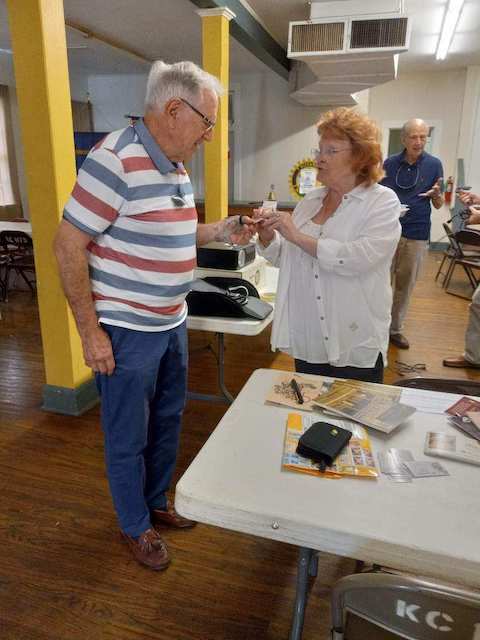
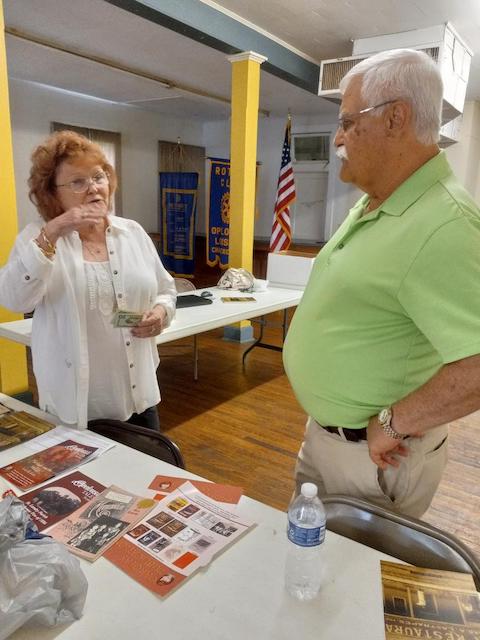
Photograph: Carola Hartley visits with Opelousas Rotarian Marty Roy following the presentation. (Photograph by Bobby Ardoin.)
BOBBY ARDOIN
Editor/Consulting Writer
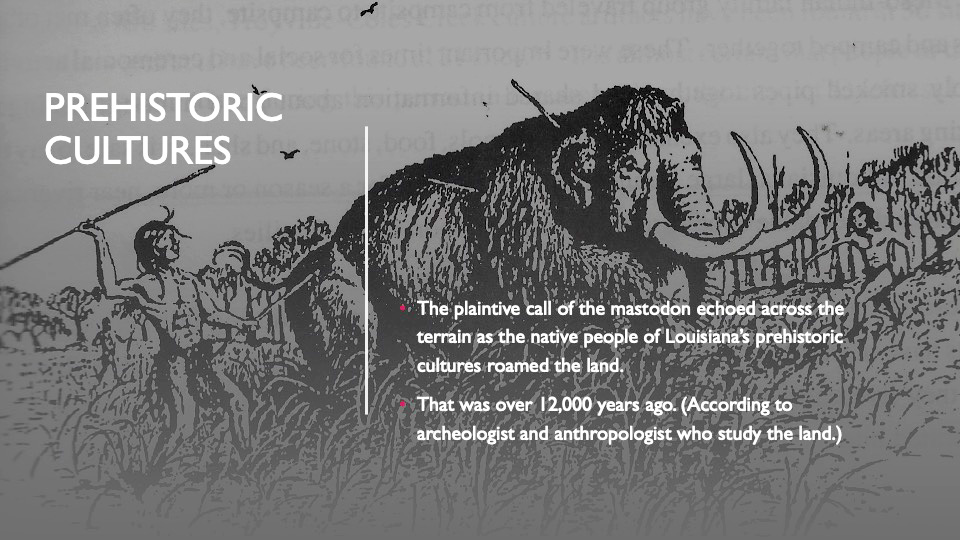
Opelousas Rotary Club members rapidly became time travelers Tuesday as they were taken on a historical trip that consumed several thousand years of St. Landry Parish history.
St. Landry Now.com publisher and author Carola Lillie Hartley used a PowerPoint presentation as Rotarians viewed during their regular weekly meeting, the major topics that have influenced the parish since prehistoric times.
Many of the issues and illustrations presented during the 35-minute snapshot of Opelousas and St. Landry originated from material included in the series of books that Hartley has authored on various parish wide sociological, religious, economic, educational and demographic topics.
The Early Years
Historical research, Hartley said, indicates that French traders first began operating in the Opelousas area during the late 17th century. By the beginning of the 18th century, those itinerant entrepreneurs Hartley said, interacted with indigenous settlers and probably brought with them the first African Americans.
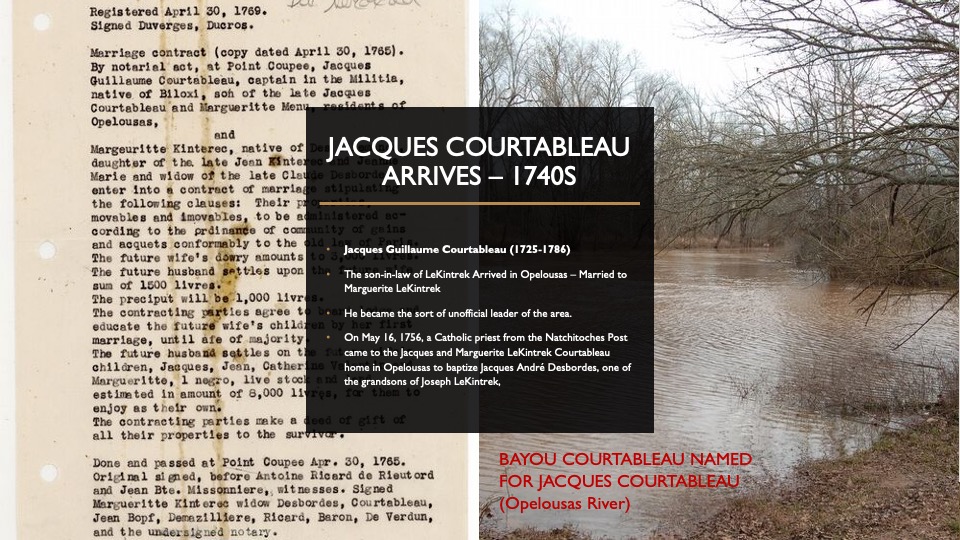
Later traders like Jacques Courtableau began trading and obtaining land around the Opelousas and Washington areas. By 1763, there is historical evidence that Opelousas became a frontier trading post with a commandant.
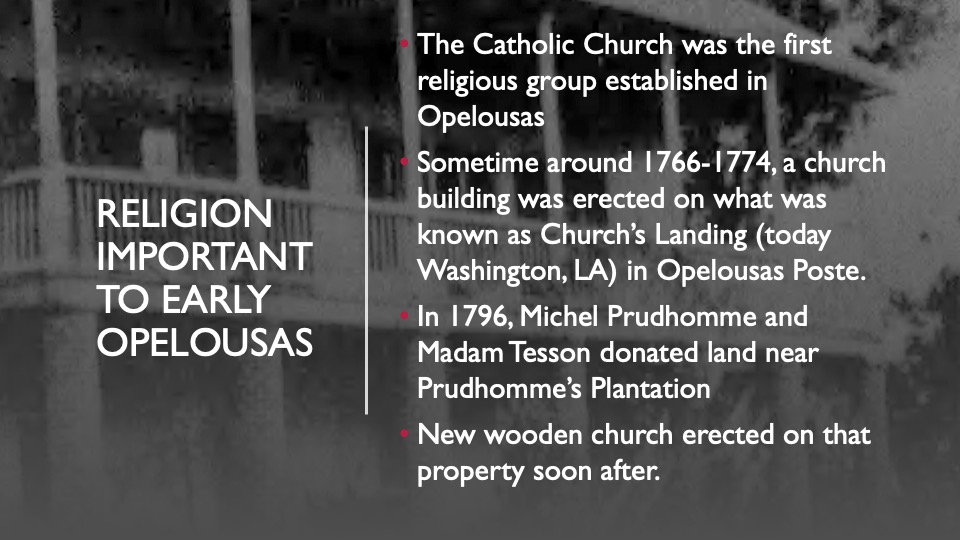
The settlers who followed, Hartley pointed out, were predominantly Catholic and by the 1770s the area had a church in Church’s Landing (near today’s Washington, LA). In 1796, the Prudhomme family, along with Madame Tesson, donated land for a new church located in what is present day Opelousas (where the St. Landry Catholic Church is located today).
19th Century
By 1807 Opelousas became the parish seat with a commercial area forming around the St. Landry Parish Courthouse in what is today the downtown. Many women, including women of color, became prominent businesswomen in the emerging town.
Protestantism and Judaism developed citywide during the early 19th century after the Louisiana Purchase was signed. Economically Opelousas developed into a town that the New Orleans Gazette newspaper noted contained taverns, churches, saddlers, tailors and tanners, Hartley noted.
St. Landry Catholic Church had a new church building in 1827 and the first newspaper, the Opelousas Gazette, began publishing that same year.
A number of schools began operation during the 1830’s and 1840s, including the College of Franklin that was located on what is today Railroad Avenue.
Union troops occupied Opelousas in 1863 a year after the city became a temporary Confederate capital. Newsprint was in short supply during the occupation and Hartley pointed out that editors used wallpaper for printing local news.
The ensuing Reconstruction Era brought parish turmoil. Newspapers printed opinions aligned with political parties and the chaos apexed in 1868 during the Opelousas Massacre, which featured violence and fatalities among blacks and whites.
Rotarians became interested in the 1886 parish courthouse fire, whose origin was unsolved until recently when Hartley said she received information that the blaze was apparently intentionally set by an accused cattle thief who vanished.
By the 1890’s Opelousas had developed into a city that contained a jail, opera house, several hotels and banks, an African-American postmaster, boarding houses and newspapers. Those economic developments followed the railroad industry which began operation in the city around 1881, Hartley said.
In 1898 Opelousas had a mayor and an elected Board of Aldermen.
The 20th Century
Hartley said the slogan in Opelousas in 1900 was “moving forward.” Hundreds of orphan train riders from New York City arrived first in 1907 and a year later the Academy of The Immaculate Conception began educating students in their new building constructed on the corner of Main Street in 1908. Prior to that the school, started in 1856, was located on Convent Street.
Opelousas and the nation was captivated by the Bobby Dunbar kidnapping and criminal trial that ended in 1914.
In 1920 Opelousas had a new church parish for the Black population with the opening of Holy Ghost Catholic Church on Union Street. St. Joseph’s School, started in the 1870s, became Holy Ghost Catholic School a year later in 1921. Also during that decade, Opelousas featured a first library in 1927, while
automotive and department store businesses attracted downtown customers, said Hartley.
The pervasive 1927 flood that inundated eastern St. Landry brought evacuees
to Opelousas.
Newspaper history was made in Opelousas in 1939 when the Daily World began publication on Christmas Eve of that year. It was the first offset printed daily newspaper in the nation. By the 1950’s Opelousas realized another dose of economic growth, but just over a decade later, consumers began leaving the
downtown area and shopping in the Creswell Lane area, which moved shopping southward, a transition that Hartley said still affects the city today.
Photographs by Bobby Ardoin