BOBBY ARDOIN
St. Landry Now.com Editor
For several decades most of the highly-trained World War II U.S. Army Ranger battalion members were unwilling to reveal the depths of their war experiences that were guided by stealth and precision.
Those years of their personal reticence were continuing until they met David Williams.
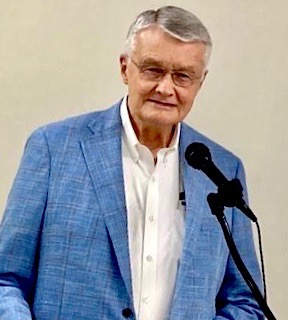
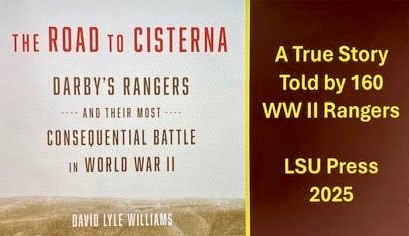
In his recently-published book, “The Road To Cisterna,” Williams, whose uncle James Lyle was a decorated Rangers’ officer, lets members of the Rangers, who specialized in what was then a unique style of commando-style, hand-to-hand of warfare, tell their own stories.
Williams, who lived in Opelousas for many years before moving to Lafayette, began attending several Rangers’ reunions to learn more about his uncle.
It was at those reunions, Williams said, that he met many of the men who served with his uncle, eventually capturing the trust of Rangers veterans.
His resemblance to his uncle, Williams says, was perhaps a contributing factor as the Rangers, now aging and dying off, gradually began to open up to him about fighting German and Italians up close and leading raids behind enemy lines in North Africa, Sicily and Italy.
The book published by LSU Press, is now available on Amazon and has sold over 2,500 copies along with acclaim from military experts.
Next month Williams and his wife, the former Jane Ellen Moise, are scheduled to accept the annual Colby Award, presented to a book that best represents aspects of military history.
“I never thought that I would write a book,” Williams told members of the Opelousas Noon Rotary club last week.
However, Williams already possessed a voluminous cache of interviews, personal accounts and stories from decorated Rangers’ who are now all dead.
Williams had made the decision over 20 years ago that he somehow needed to find a way to divulge their experiences from 1942 until the decisive Rangers-led battle at Cisterna, an important road junction about 30 miles south of Rome.
Ultimately Williams said he had no other choice than to get started with his book.
“I was in the lumber industry for 50 years and in 2020 I decided to sell his business. My wife told me then that if I was going to write a book, I better get busy, because I was getting old,” said Williams, a former Army officer.
“What I did with this book is let the Rangers speak for themselves,” said Williams, who also draws from letters written home to family members as well as accounts provided by relatives of the Rangers.
Most of the Rangers, who experienced the destruction of two battalions at Cisterna, didn’t want to discuss what they had seen from 1942-44, Williams pointed out.
“Most of them came back with survivor’s guilt. They didn’t want to talk about it because for them, it would open old wounds,” Williams told the Rotarians.
One of those silent veterans was his uncle, James Lyle, who Williams said he idolized as a youngster.
“For some reason, (James Lyle) picked me to start telling me about the Rangers, things he never told to his family,” said Williams, who was given his uncle’s war memorabilia, medals and commando knife used by the Rangers to silence enemy sentries as they silently moved through missions.
It was through those conversations with his uncle, Williams said, that he learned about the selective process used by the Rangers’ original commander, William O. Darby, to choose the men in his units.
William “Bing” Evans, one of the original Rangers’ officers, Williams says in his book that Evans took him to a Catholic Church late one night and extracted a pledge from Williams to maintain and expose the events that made the Rangers different from other military units.
“He told me to never let (the stories) die,” Williams explained.
Williams said he plans to visit Cisterna one day and perhaps write a Rangers sequel recounting their experiences in other World War II locations.