Talking About Neighborhoods
BOBBY ARDOIN
St. Landry Now.com Editor
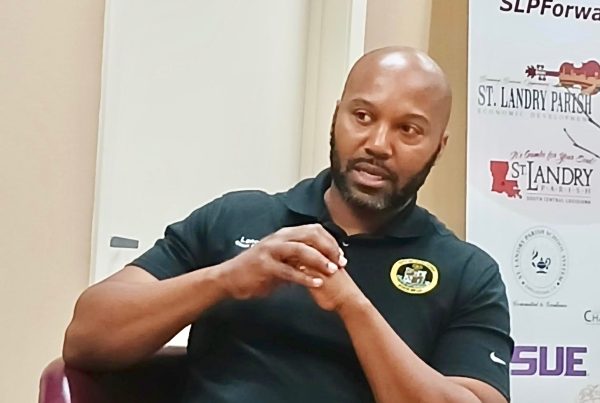
For about two hours Thursday night, they talked about their childhood neighborhoods and their memories of growing up in an Opelousas that no longer exists.
There was laughter and interaction about early life in the distinctive areas of the city, such as The Hill, Brickyard, Indian Hills, Trash Pile, Oil Mill, Garland and Opelousas’ south and north sides.
The storytelling and youthful recollections revealed at the Opelousas Museum and Interpretive Center marked the beginning of an ongoing project, whose possibilities are wide ranging, said museum director Patrice Melnick
Melnick said she and museum staff members have planned the neighborhood oral history project as a way of discovering and peeling away a citywide footprint that helps define each of the neighborhoods and what makes each of them distinctive.
“We’re also curious about the names that are associated with each of these neighborhoods and who lived in them,” Melnick told about 25 persons who showed up to reflect on the areas where they once lived, played and matured
Participants were presented with maps of the city and asked to draw the physical neighborhood boundary lines.
What makes each neighborhood so distinctive? Who lived there? What about daily life? How does it look now compared to then?
This is what Melnick said she and her staff want to discover through the eyes of those who lived there..
Periodically the storytelling sessions will be renewed, as those involved will be encouraged to bring memorabilia and photos linking past and present.
“Everyone (on Thursday night) is a storyteller. Were there landmarks in your neighborhood that stood out? Do they still exist?,” Melnick wanted to know.
About 70 years ago, The Hill was a vibrant entertainment area, filled with nightclubs. Neighbors there weren’t afraid to walk after dark on Saturday night or ask neighbors to borrow ingredients for baking, one woman told her audience.
“Now Opelousas has changed,” she said.
People from outlying areas, said another female attendee, often came to Opelousas for entertainment.
“What can we do to commit to bringing that back to Opelousas?” she asked.
The older southside residential area just beyond South City Park, provided youths with multiple activities, such as swimming and recreational baseball. Bike rides to the park were made easily and you didn’t need to lock your wheels upon arrival, said another male participant.
The same was true in most of the city’s other neighborhoods, he added.
“People I know from back in the ‘50’s talk about what a great place (Opelousas) was to grow up in back then. No matter where you lived or the demographics that were involved it was the same vibe,” he said.
Melnick said the possibilities and what can ultimately be done with the information included in the neighborhood storytelling project will be discussed further at other meetings.