

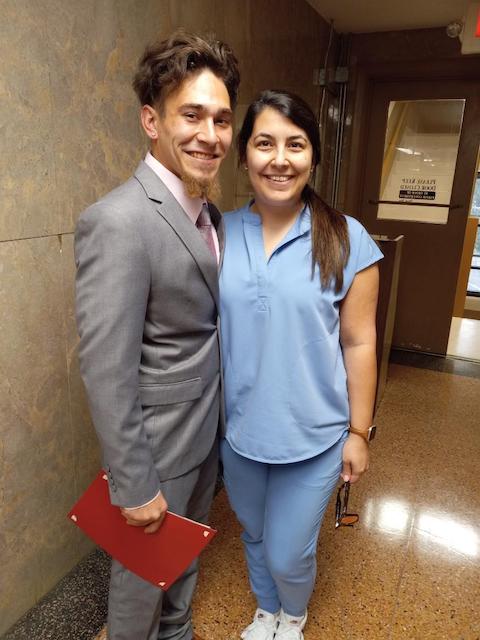
Featured Photograph: Drug Court Graduate Rickey Thibodeaux with cousin Sarah Andrus. (Photograph by Bobby Ardoin.)
BOBBY ARDOIN
Editor/Consulting Writer
The 12 newest graduates of the St. Landry Parish Adult Drug and Specialty Court program this week have had their criminal charges dismissed, but what happens to them now that they now are free from prosecution?
Their future lives now will at least include a more promising path with the opportunity to help others, said one State District Court judge, as the graduates celebrated the completion of their individual programs during a ceremony conducted before friends and family.
District Court Judge Gerard Caswell reminded the graduates before they were recognized for completing the court diversion program that their friends and family were perhaps the ones most anxious to applaud the successes noted on Wednesday afternoon.
“Your apology is worthless without a change of behavior. (The graduates) took that opportunity of having charges pending to get to this point. Your past is what got you here. You should look back now and be hopeful that your sobriety can be helpful to those around you and others who need help,” Caswell said.
For Ricky Thibodeaux, once an admitted heroin addict, releasing him from a potentially lengthy jail sentence is something he thinks will provide him with another chance at redemption.
That wasn’t the case too long ago, Thibodeaux said.
“I was a lost cause and where I am today is a long way from where I was coming from. I had been doing drugs, selling drugs for 14 years. I was heading for prison and for the grave. I’m 36 now, and I see now that good things happen. It seemed like most of my life I was out there on the streets,” said Thibodeaux, who is now employed.
Program coordinator Norman Rene told the graduation audience that Thibodeaux, who was living at the Opelousas Refinery Men’s Shelter eventually became a role model for others in the drug court program.
“A lot of people showed up in drug court because of (Thibodeaux). He told them if I can do it, then you can do it,” said Rene.

Brett Matte said he was in “drug trouble,” and initially had difficulty progressing through the diversion program.
“The whole first month it was no progress being made. It was that way for a while until something clicked. I can’t say how that happened, but now it’s been two years that “I’ve been sober. In addition to the persistence from the program coordinators, Matte, who works laying asphalt, said he had family support that was additionally important.

For Antonio Brown, entering the drug court program was a significant step, especially since he was facing a fourth DWI charge.
“Coming into the program is something I definitely needed. I was confused. I had some great discussions here (in the drug court program) and I was having my ups and downs since I was in the program. I was able to meet with people and I realized that this is going to be a lifelong journey,” said Brown, who is performing carpentry work in the Eunice area.
Trevor Devillier was faced with drug charges and arrests, a situation which gave him a choice.
Rene described Devillier as a good candidate for success.
“Trevor came into the program and we immediately saw that he is smart, an intelligent young man. He has a supportive family and once (Devillier) decided what he really needed to do, he took off,” said Rene.
Devillier said in an interview that it took him a while to conform to the steps needed to complete the program, but he was proud that he had completed his effort.
Treatment Director La’Pearl Simmons said 351 individuals have graduated from the drug and sobriety court program since its inception in 2002.


