

Photograph: St. Landry Parish Courthouse in downtown Opelousas during the 1850s decade.
Carola Lillie Hartley
Publisher and Contributing Writer
Note: At the presentation on the Visual Historic Tour of Opelousas at the museum last Tuesday evening, there were several questions about Hi-Fa-Lu-Ti, a small book published during the 1850s decade. The following is a story about the book that will help to answer those questions.
Hi-Fa-Lu-Ti and Opelousas Politics
Studying the history of our community I’ve learned so much about the past and the people who lived that past. It’s fascinating to discover how our ancestors reacted to different occurrences of their lifetime. Take local politics, for instance. The reaction to the political wars going on in town during the middle decade of the 19th century were both grave and comical. Have you ever heard of Hi-Fi-Lu-Ti? To find out what that was, lets travel back to Opelousas in the 1850s.
By the 1850s Opelousas was a growing town. Having survived an outbreak of cholera during the 1840s and the Yellow Fever epidemic during the previous decade, the town was now back on its feet and experiencing tremendous growth. New businesses were established around the St. Landry Parish Courthouse, and by 1852 the town had two newspapers. New people were settling in Opelousas. Franklin College, although no longer the institute of higher learning, was again in operation as the Opelousas Academy, a boy’s school supported by area citizens. By the middle of the decade, the St. Landry Catholic Church opened a boys’ school followed by a girls’ school a year later.
The Opelousas Courier of October 8th, 1853, reported the following: “Most of our friends, encouraged by the news ofthe healthy situation of our town, have come back amongst us. Business is reviving slowly, stores are opening, and our citizens look quite happy.”
A feeling of new hope filled the air. There were not just business and educational opportunities, but new social events in town, offering citizens an attractive quality of life for that era. There were horse tracks with racing events, town dances, and other musical entertainment that filled the Opelousas Varieties Opera House.
With great anticipation the town was waiting for the coming of the railroad to help connect Opelousas to the rest of the state. The New Orleans, Opelousas and Great Western Railroad Company (NOO&GW), chartered in 1852, promised passenger and freight trains would reach Opelousas by the end of the decade. In 1855, the Opelousas Courier announced train service had reached Terrebonne Parish, inching its way towards Opelousas. After experiencing some of its worst years, it was finally the best of times in the town.
Even with all this progress, some local citizens described 1857 as exceedingly dull in Opelousas. However, an event happened during that summer that fueled local politics and created town talk for some time. That story has survived from generation to generation. Politics in Opelousas and St. Landry Parish has always been fiery!
As the story goes, following a heated parish political campaign, two little paper bound books were published in the summer of 1857. The first was called “The Horse Race,” subtitled “Grand Four-Mile Race, Purse $10,000.00.” It paralleled a political campaign of the day and gave the names of the two entries, their trainers and their riders. The names of characters were changed, but they were still recognizable. This upset many prominent Opelousas residents.
It was not unusual for a horse race to be used to describe a political race of the day, especially in St Landry Parish. During that time horse racing was a very important sport in the area and had been for decades. There were regular races scheduled at the Bellevue Course in Opelousas and other area horse tracks for many months throughout the year.
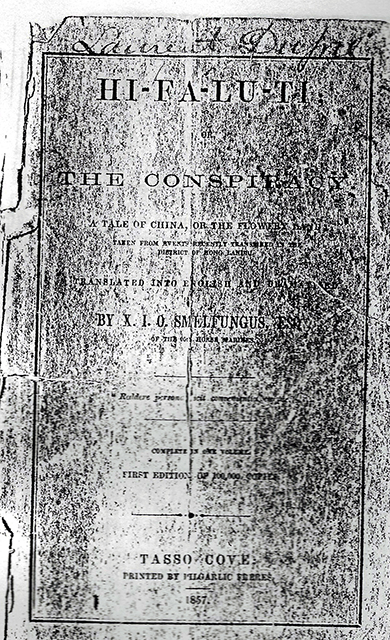
As a result of “The Horse Race,” another book titled “Hi-Fa-Lu-Ti or The Conspiracy,” a longer bit of satire, was published shortly thereafter. The book was printed in one volume, first and only edition of 100,000 copies, by Pilgarlic Freres of Tasso Cove. It was translated into English and dramatized by L. I. O. Smelfungus, Esquire of the Ninety-fifty Horse Marines.
“Hi-Fa-Lu-Ti” is quite a document. According to the cover, it is a tale of China, or the Flowery Land; taken from events recently transpired in the District of Hong Landry. The story opens with a not so flattering description of one of the parishes political groups. The made-up names concealed the identity of prominent Opelousas and St. Landry Parish citizens who starred in the drama, but it was easy to know who they really were.
Private things were revealed about people in the parish. Those represented included the District Attorney, Clerk of Court, Methodist Minister, several judges, doctors, lawyers and well-known businessmen and civic leaders.
Opelousas was a buzz when “Hi-Fa-Lu-Ti” was released. Prominent people of the town, who were ridiculed in the story, quickly bought and destroyed all the copies they could find. High prices were offered for any copy found in the area.
Dr. James Ray of Opelousas wrote about the publication in a letter to a New Iberia relative in July of 1857. Part of that letter read: “…a great deal of excitement yet exists among the party that Mr. Smelfingers has portrayed so beautifully. The pamphlet is entitled Hi-Fa-Lu-Ti. I presume you have heard of it. I have myself a copy for which I could get $50.00 if I wished to dispose of it. There were only some ten or fifteen copies sent to this parish and they have all disappeared mysteriously in consequence of which the demand for these copies left is very clamorous. I know of but three that remain and those could not be borrowed from the holders not even by their fathers. It appears to be regarded by them as a precious jewel.”
After reading “The Horse Race” and “Hi-Fa-Lu-Ti,” people knew not only who the actors were, but what they stood for. The publications remained the talk of the town for years. Even as late as 1929, the story was being discussed. On September 2nd of that year, a letter was written to Judge Gilbert L. Dupre asking him to help identify the players in “Hi-Fa-Lu-Ti.” At that time a list was handwritten, and then typed, with the names of the real people talked about in the famous publications. Even then the list was carefully guarded.
The writer of “Hi-Fa-Lu-Ti” was never really known, although several people were named as suspects. And it is curious to note that right after the publication was released, in July of 1857 there was a war of words being played out by the editors of the two Opelousas newspapers, Joel Sandoz of the Opelousas Courier and Charles Ealer of the Opelousas Patriot. In his July 18th edition of the Patriot, Ealer claimed Sandoz was the writer of what he called the “Hi-Fa-Lu-Ti” prospectus, and Sandoz claimed in the July 25 Courier that it was actually Ealer who authored “Hi-Fa-Lu-Ti.”
Well into the 20th century, the story of “The Horse Race” and “Hi-Fa-Lu-Ti”, handed down from generation to generation, was discussed by some of the old folks of Opelousas. They referred to the incident as just politics in old Opelousas.
Have a question about Opelousas and its history?
Send your questions about Opelousas history to me at carola@stlandrynow.com and I will try to provide an answer for you.
Photo: Drawing of the St. Landry Parish Courthouse as it appeared during the 1850s in downtown Opelousas.


