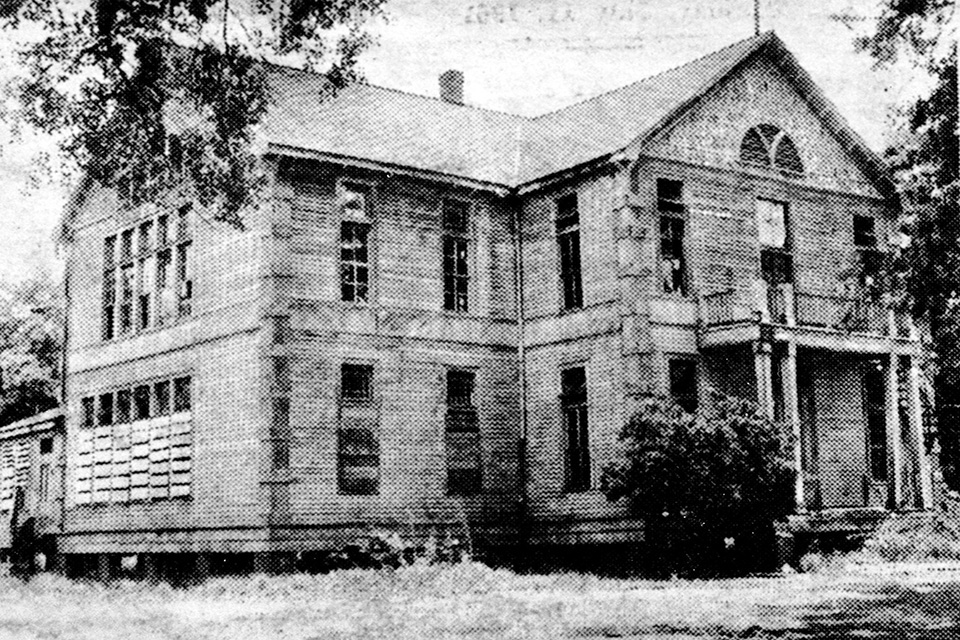
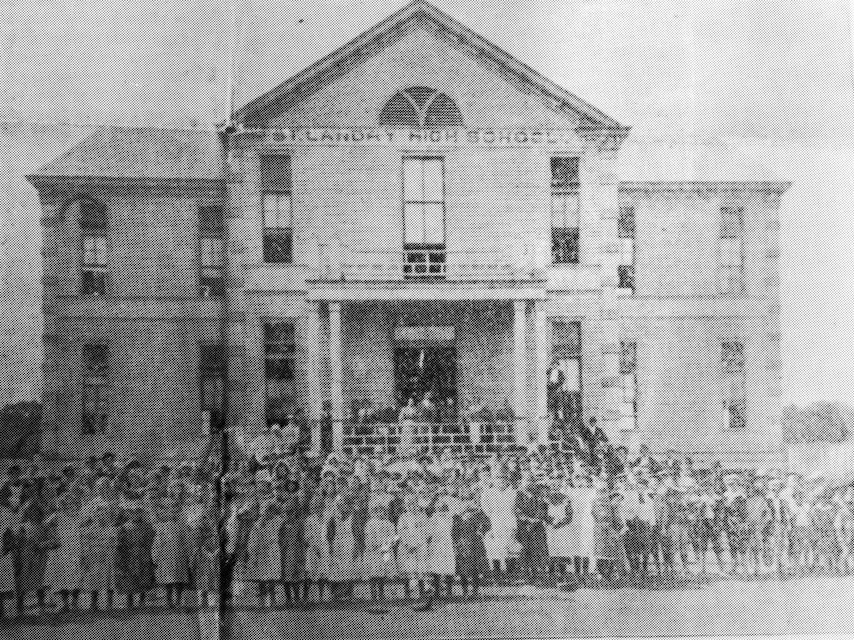
Photograph: The new St. Landry High School as it appeared soon after it opened on the corner of North Market and Bloch streets in Opelousas. This photography, courtesy of Joan Carr Dubuisson, is one of the earliest photographs of the school, possibly taken on the day of its opening in January of 1894.
Carola Lillie Hartley
Publisher and Contributing Writer
Although there were several attempts at public education in Opelousas for some time prior to the 1890s, the first public high school in Opelousas that had support and survived was the St. Landry High School established in 1893. Here is the rest of that story.
Opelousas Education Brief History
The history of education in Opelousas is similar to the history of education in the south. The first schools in St. Landry Parish and Opelousas were private or associated with the churches. As early as 1821 the parish had a Catholic school with the founding of Sacred Heart Academy in Grand Coteau. Just a little over a decade later the Jesuits from France and Kentucky opened St. Charles College in the same town. And in 1855 St. Mary’s Academy for boys was founded in Opelousas by Father Gilbert and Francois Raymond. The following year the Academy of the Immaculate Conception for girls was opened by the Marianites of the Holy Cross. Also, in 1856, St. Mary’s Hall, a private school, opened in Washington. And in 1874 the Sisters of the Holy Family founded St. Joseph’s school to provide Catholic education for Black students. And as the decades went by more local and area religious and private school were established.
As early as the 1830s the Opelousas area had a school for Free Negroes when the Grimble Bell School was established. It was an elite private school located near Opelousas and Washington for the education of children of the wealthy Free People of Color planters in the area. According to reports including one in Harper’s New Monthly Magazine of June – November 1866, during the 1830s this school had 125 students enrolled and four teachers. The monthly tuition was fifteen dollars. The school taught all customary subjects, including writing, arithmetic, history, bookkeeping, French, English and Latin. However, by the late 1850s the school was forced to close due to racial tensions.
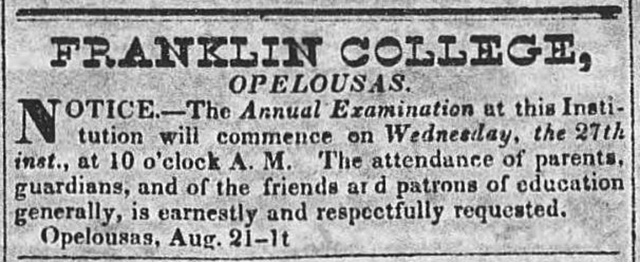
But there was little support for public education in the area. The lack of public education was a topic of discussion for many years in Opelousas. During the 1830s, a group of citizens were concerned about this and worked to established Franklin College. However, the support for this endeavor was not there and the school soon closed.
In 1854, the local newspaper reported there were 2,632 school children in St. Landry Parish in March of that year, according to Robert Benguarel, who was the parish school treasurer. There were nineteen free public-school districts in the parish at that time. But these public schools were not the best quality. So those who could afford it sent their children to church and private schools or schools in other areas.
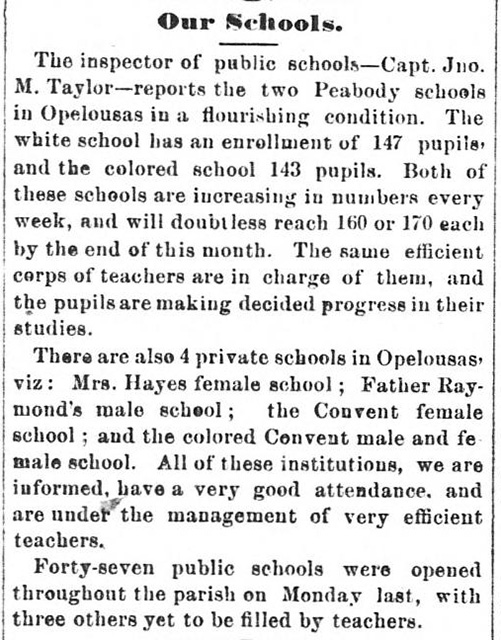
Following the Civil War, there were public schools established in the parish, with a parish school board. However, these schools were not well supported by the general public. Opelousas also had Peabody schools after the war, funded with grant support from George Peabody of Maryland. Peabody established the Peabody Education Fund to “encourage the intellectual, moral, and industrial education of the destitute children of the Southern States.” (We will have more about the Peabody Schools, for both whites and blacks, in a future article.) Following the closing of the Peabody schools in the early 1880s, a new educational era began in Opelousas and St. Landry Parish in 1888.
A Public-School Building for Opelousas
During 1888 citizens united in a call for a mass meeting to consider the question of the construction of a public-school building in Opelousas. The meeting was held in the courthouse, with Laurent Dupre as chairman and Thomas H. Lewis as secretary. A standing committee of 25 ladies and gentlemen was appointed and charged with raising the necessary funds to construct the building. Dr. V. K. Irion, a local dentist, was appointed chairman. After three years, the committee had raised only $1,200. Realizing the process was going too slow, the Committee of Twenty-Five decided to present a petition to the Opelousas Board of Police asking that body to call a special election of the taxpayers of the town to levy a 2 1/2 mill tax for eight years to fund the school.
Reacting to that petition, in 1891 the Opelousas Board of Police appointed a committee to look into building a public school. The committee of three, J. B. Sandoz, E. J. Clements and E. Latreyte, called for an election in order to create a tax for this purpose. The tax passed. Following this, a Board of Commissions was formed with J. B. Sandoz, George C. Pulford, E. Latreyte (from city government), Captain J. J. Thompson (from “Committee of Twenty-Five”) and Dr. V. K. Irion (from the school board) as members. The Board of Commissions selected and purchased a building site on North Market Street containing about seven arpents (on the site where the old St. Landry Clinic stands today). The land cost $1,050.00.
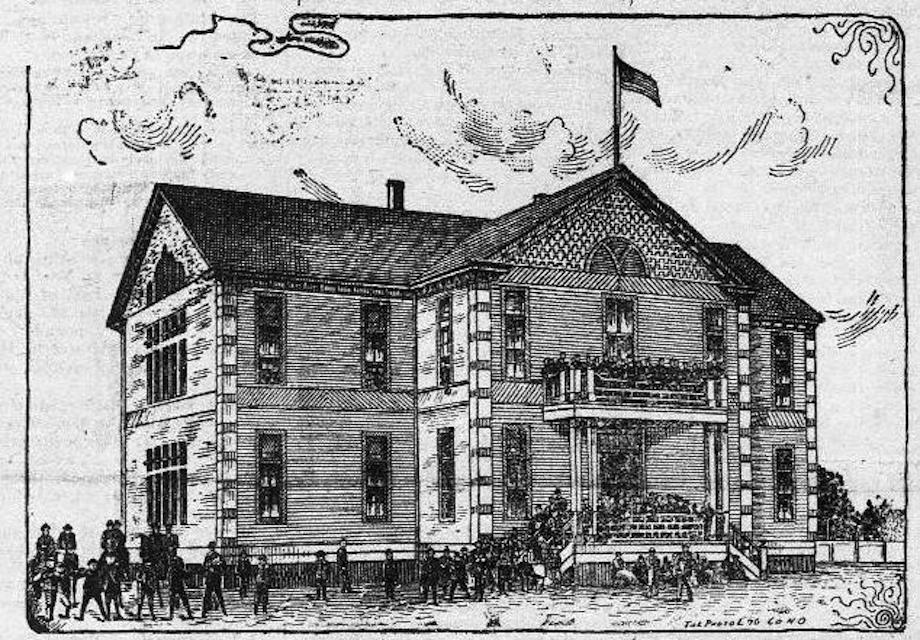
The contract to build the school was awarded to Mr. George Chachere on Saturday, September 2, 1893.The total cost to construct the two story, eight-class room building, with an office for the principal and a chemistry laboratory, was $8,500.00. The building was furnished at a cost of $1,200.00.
St. Landry High School Established
In the winter of 1893, the school board established the St. Landry High School and a grade school. The first session, which continued for six months, opened on January 2, 1894 with 157 students enrolled on the first day.
The first high school faculty included Dr. V. K. Irion, acting principal pro-tem, Professor G. W. Jack, the main teacher, and Miss Effie Ealer. Other department faculty included Professor Jack, Miss Hebrard and Miss Ealer for Grammar, Miss Birdie Harmanson and Miss Ealer for Intermediate, and Mrs. R. Mayer and Miss Hilda Mayer for Primary. The local trustees were E. North Cullom, C. J. Thompson, G. L. Dupre, Joseph Bloch and Dr. R. M. Littell. A group of ladies consisting of Mrs. Laurent Dupre, Mrs. G. L. Dupre, Mrs. F. G. Marks, Mrs. F. E. Bailey, Mrs. C. B. Andrus, Mrs. V. K. Irion, Mrs. K. V. Johnson and Miss Fannie McKinney assisted in raising funds to furnish the school house.
First St. Landry High School Graduation
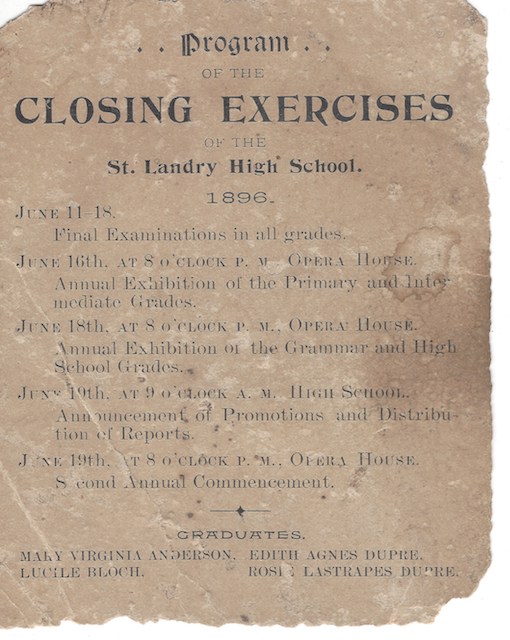
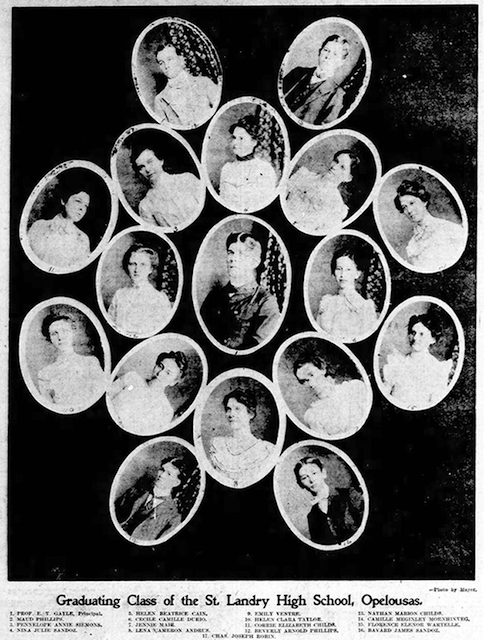
The first St. Landry High School graduation class consisted of only one student, Miss Belle Dupre. Newspaper accounts of the first commencement held in June of 1895 stated it was very successful with a large crowd in attendance. The first part of the commencement ceremonies began with entertainment for the primary and intermediate department of the school on Thursday evening, June 20, 1895 at the Sandoz Opera House in Opelousas. A large crowd gathered to see and hear the school children preform music, song and pantomime drama.
The following evening, Friday June 21, the graduation exercises of St. Landry High School was held at the school building. The program presented included the history of high school, delivered by Miss Lucille Bloch, with other addresses by school board members, public officials and school personnel. The main address, an essay on “True Womanhood,” was presented by the honored graduate Belle Dupre, who received a standing ovation for her delivery. As the newspaper account stated, “at the end of the evening students, teachers and parents were all congratulated and elated.”
First Official Principal
Following that first school session, in October of 1894, the school hired its first official principal, Professor Charles Grant Shaffer from New Jersey, a graduate of Harvard University. His salary was $100.00 per month.
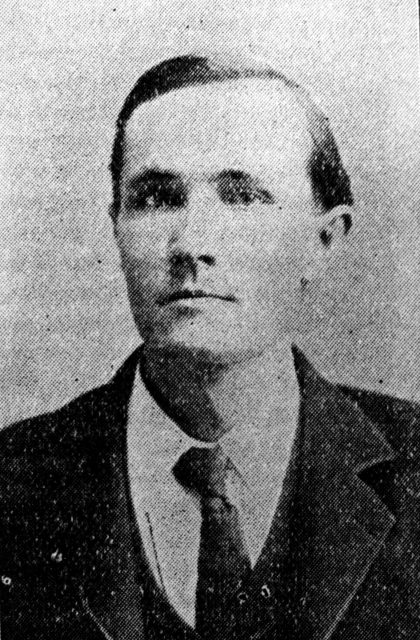
Professor T. H. Harris was hired as the principal of St. Landry High School in 1896, and in July of 1897, he was rehired for a salary of $125 per month. Harris remained in Opelousas until 1900 and later became the state Superintendent of Education, a position he held for a number of decades. T. H. Harris Trade School in Opelousas was named in his honor.
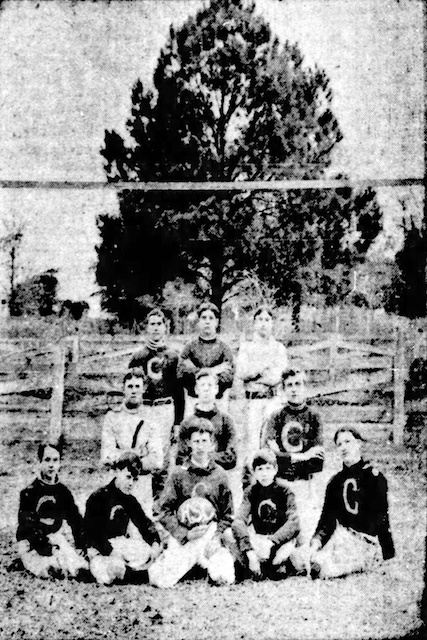
The St. Landry High School operated in the wood framed building on North Market Street until 1914 when a new brick high school building was completed on South Street and opened for the 1914-15 school year. That new brick school eventually became Opelousas High School.


St Landry Training School
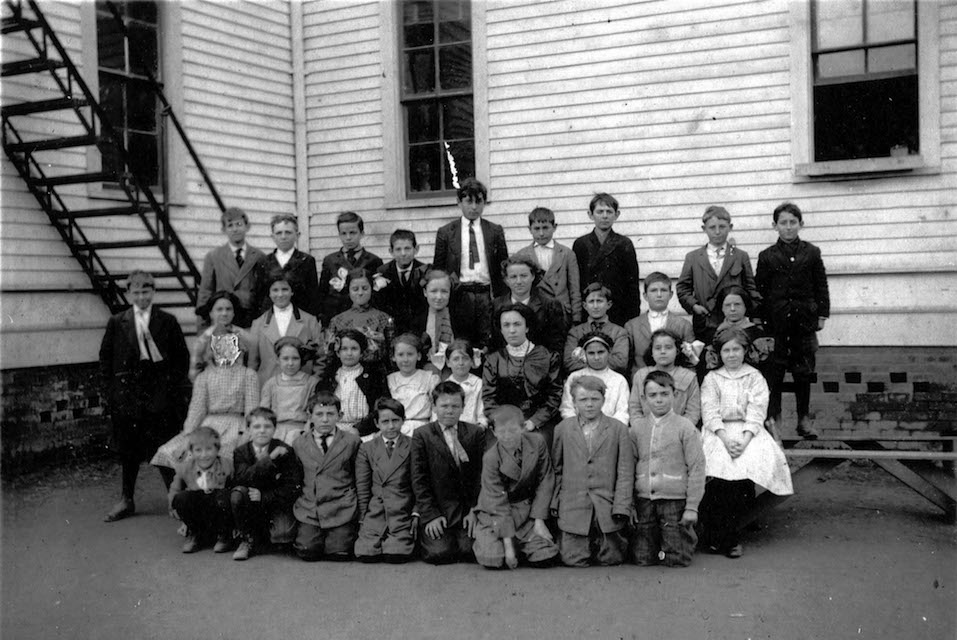
The old school building on N. Market Street remained vacant for a few years until 1918, when it was sold, dismantled and moved to the corner of Vine and Academy streets. After the building was moved and put back together, it became the Opelousas Colored School. It eventually became known as the St. Landry Training School, so named because the building was also used during the early days as a training facility for all the Negro teachers in St. Landry Parish.


Years later, a new building was constructed to house a more modern school for Blacks, and that school became J. S. Clark High School in 1953. J. S. Clark and Opelousas High School were merged in 1969-1970 and both schools became Opelousas High School (OHS).
What Became of the old building?
When the new J. S. Clark School building was constructed in 1952, the old St. Landry Training School building, that at one time housed St. Landry High School, was abandoned for about three years. In 1955, the school board remodeled the building and used it to house five classrooms for a few years. Later the building was only used for storage. In 1960, the school board advertised it was accepting bids to sell the old school building. However, the only bid offered was $600. That was rejected and the School Board kept the building until July of 1961 when it advertised for bids to purchase the building, remove it from the site on Academy Street, and have the site cleaned and leveled. (Daily World, Opelousas, LA, July 7, 1961.)
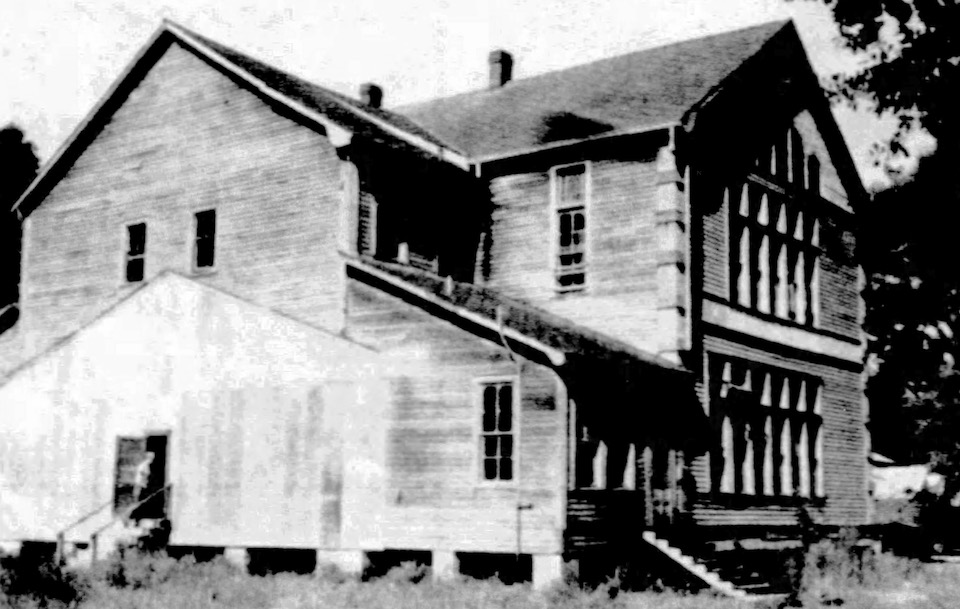

On August 3, 1961 the School Board sold the old building to Charley Robert for $1,040, with the understanding that the building had to be moved from the property and the property cleaned and leveled. (Daily World, Opelousas, LA, August 4, 1961.)
Another part of Opelousas history was lost when the building was taken down in the latter part of 1961.